
Zakat Report: Hundreds of Millions in Fake, Wasted and Hoarded Donations
A Review of 17 Zakat-Collecting Nonprofits

Note to readers: I have corrected errors where noted. I have an update after the response to this article you can read here.
“Woe to the defrauders!”
— Qur’an 83:1 (Al-Muṭaffifīn)
The Muslim international charitable sector is awash in misleading marketing, online influencer slop, and even outright theft. The recent scandal involving Khaled Beydoun and Human Appeal is only the most recent and cartoonishly vile example of a more systemic problem. The purpose of this article is to move beyond scandal and to instead evaluate charitable organizations using a consistent financial methodology and offer some suggestions for reform. I begin with introductory comments on what I call “hisab-hacking,” continue with a review of 17 Muslim charities—none of which I can recommend for zakat—and conclude with suggestions on how to move forward. I do have some suggestions on where you might consider donating, but these options are unfortunately outside of the Muslim-run international charity sector. I have excluded organizations that are too small or niche for meaningful comparison.
Part 1: How I Evaluate Charities
“Whoever cheats, he is not one of us.”
— Hadith of Muhammad ﷺ
The Arabic word ḥisāb has to do with accounting, reckoning, and calculation. It appears in the Qur’an and conveys similar meanings in Urdu, Farsi, Swahili, Indonesian, Malay, Turkish, Uzbek, and pretty much every other tongue in the entire global Muslim language stack. The term is significant because it links financial accounting with moral accounting—a connection seemingly lost on international Muslim charities that are dishonest with Muslim donors.
This report focuses on 17 organizations that collect international zakat, reporting a total revenue of $924 million. Of that amount, $493 million does not exist; it is phantom revenue resulting from a discredited accounting tool. This move, which I term hisab-hacking, is used by many Muslim organizations to deceive Muslim donors. Through hisab-hacking, mediocre or even scammy “zakat Madoff” charities come to appear like lean philanthropy superstars. Here is how it works.
The “Program Expense Ratio” is the pretty number Muslim charities will advertise when they speak at the masjid in Ramadan. It is the number that describes how much of your donation actually goes to charitable programs versus things like advertising, administration, salaries, and travel. See, for example, Muslim AID USA’s page on Charity Navigator (below). While MAUSA is quite middling as far as this deception goes, it provides an illustration of what is happening:

What a donor may understand from this number is that the charity is “efficient” and lacks significant waste. 93.17 is a fantastic number from a donor’s perspective; the only problem is that it is a complete lie. A common way charities rig this number is by claiming “program” expenses for things like salaries and advertising, even if the organization does not engage in any charitable activities itself. This is a common tactic and we correct for it in the numbers. But hisab-hacking is different; it invents money that never existed.
Imagine Aisha sees scarves at a discount retailer priced at $1 each, down from $21. She buys 20 of them as gifts to girls in her 4th grade class and a couple of nieces. She then reports this as $400 in income on her tax return. You should recognize that this example makes no sense: Aisha would not do this unless something was wrong with her. However, several organizations in the Muslim charitable sector do something similar. They claim the ‘discount’ off retail price is a charitable donation even though they paid for the goods. They may also take items they received for free and overvalue them to an absurd level. There is no logical reason to do this except that by changing the numerator, they put lipstick on the proverbial pig.
A nonprofit organization will often purchase medical supplies from a medical supply warehouse and record the “discount” as a donation. These warehouses provide the goods and ship them directly to the nonprofit’s designated location, with the charity rarely taking physical possession or even inspecting the items. In many cases, the supplies cannot be sold in the United States (for good reason) and concerns about the quality of such goods have long been a chronic problem in the nonprofit world. The World Health Organization and others have shown that many donated medical supplies are junk destined for landfills. Regardless of the quality of the supplies, the goods are quite cheap compared to the value attributed to them in their accounting.
In its IRS Form 990 filing from 2024, MAUSA reported paying $391,398 in “handling fees” for what was booked as over $16 million in revenue (most of the organization’s purported revenue). Understand that this money does not exist. It was produced with accounting magic that deceives donors into thinking the organization is bigger than it actually is. This is useful for setting CEO pay since bigger organizations can pay more. Second and more important, the ruse serves to hide fundraising costs and the costs of administration as a percentage of overall revenue. The Attorney General in California has made efforts to stop this exact deception scheme and even has an explainer that addresses the problem. This misrepresentation amounts to fraud against the Muslim community as it is an active effort to mislead people into donating to MAUSA.
We know from the 990 that MAUSA’s actual numbers, after excluding the hisab-hacking problem, would be unappealing to donors. Nearly half of the money people donate to the organization never leaves the office. And MAUSA actually outperforms many of its peers when it comes to waste! Across the 17 organizations I discuss in this article, that waste adds up: of $430 million in real cash donations (remember we already corrected for hisab-hacking), $224 million—a majority—was either burned on domestic overhead or hoarded by the organizations themselves, never reaching a donor-intended charitable beneficiary. Hisab-hacking is the main way charities can keep marketing at masjids where people ask questions about program efficiency ratios. Hisab-hacking is how the charities can pull the wool over the eyes of Muslims.
What you should also understand about MAUSA is that it does not conduct any charitable activities itself. This is common but not universal in the Muslim charitable sector. MAUSA is a “marketing first” nonprofit, i.e., its job is to market for donations and then grant them overseas to other nonprofits. In many cases, those organizations grant to others in a Rube Goldberg machine of unaccountability, serving as a mere passthrough. Typically donors do not get any transparency about what happens to the donations through much of this daisy chain.
You may challenge the notion that an organization is a “marketing-first” charity with no charitable programs of their own because you can see pictures of branded aid being delivered by people in the organization’s vests as part of the charity’s marketing. This is known as white-label marketing or content as a service (CaaS), a model in which marketing-only charities and content creators can purchase from charities on the ground or from entrepreneurs in conflict areas or aid hotspots. In some cases, charities like Muslim Aid will request opportunities for US staff to visit to show photos and videos and “personalize” aid delivery for fundraisers. This is normal in the sector. Celebrity scholar-influencers can get what are called “hero shots” set up to demonstrate impact, even if the person does not have their own charity and the group they work with does not operate where the money is supposedly going. Marketing is not reality.
Evaluating Zakat Policies
The more abstract a zakat policy, the less useful it is to anyone. While a meaningful policy provides concrete guidelines for how an organization should and should not spend money, an abstract policy serves as empty virtue-signal marketing. However, when there is no accountability mechanism, both abstract and solid zakat policies serve the same role. To understand how this practically unfolds, we should track what happens when a Muslim donates to a charity.
Every charity review below contains a description of what happens to a hypothetical $100 donation. I use a donor-centric view of donations rather than the charity’s accounting, so all US domestic overhead is considered “domestic burn” regardless of how the charity sees it. Money granted out, even domestically, is treated as charitable activity unless it appears the spending is for marketing, donor acquisition costs, or mysterious purposes. I have reached out to various charities to clarify issues when appropriate. In the analysis below I strip out the effects of both hisab-hacking and characterization issues, in which charities misrepresent activities in the United States as programmatic even if they have no charitable programs in the country.
Marketing-first charities are treated as similarly as possible to direct implementers, who have their own programs and services overseas but sometimes also make grants. What is domestic and what is foreign can be determined from Form 990, particularly Schedule F. I cannot attest that my methodology is perfect but I do intend to refine it over time if such charity reviews turn out to be a useful service for Muslim donors.
Part 2: International Nonprofit Reviews
I recommend none of the charities listed below for zakat, as there is a sector-wide deficit in how the third pillar of Islam is handled. You might consider giving some charities a closer look for the purposes of sadaqa or to encourage them to improve policies and processes on zakat. Some charities are too mediocre to consider for anything. Other organizations should be subject to regulatory scrutiny. And some characters currently in the Muslim charitable sector should be in prison. There is a level of grift and dishonesty in the Muslim charitable sector that the community should not tolerate. The 17 organizations reviewed below are leaders in the industry, listed in no particular order.
HUMANITI FOUNDATION
Rating: Acting Guilty About Something
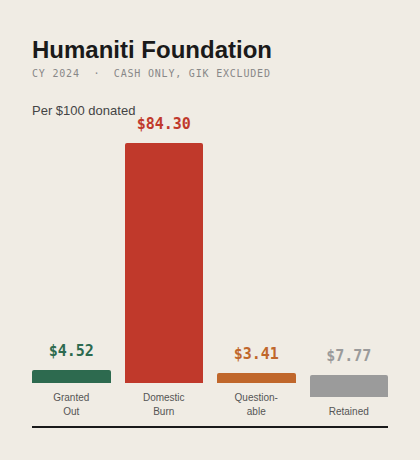
Humaniti is the weirdest organization on the list by a significant margin.
The financial picture from the organization’s 990 alone is alarming. The filing reports zero employees, zero officer compensation, and zero board members (which you legally need in Texas, where the group is based) for an organization that took in $13.6 million in revenue. Part VII of the 990 simultaneously lists three board members (Waleed Gabr, Mohammad Firaaz Azeez, and Shoaib Khan), meaning the filing contradicts itself without any outside interpretation required. The website lists what appear to be active staff. One can call the organization and actually speak to someone listed on the website (which I did). Either the 990 is wrong, or the website is. Both possibilities are serious for a federally registered charity where documents are filed under penalty of perjury.
Of the $9.27 million reported in grants, 91% ($8.39 million) is itemized with no recipient name, no Employer Identification Number, no address, and no stated purpose on Schedule I. That is classified in my analysis as domestic burn. The 9% that is named “Good Gifts” ($301,600 for Gaza assistance) cannot be located in any IRS database, ProPublica, or Charity Navigator. No EIN, no address, and no evidence of legal existence. I classify this as a cash burn. $76,000 was routed to an entity listed as “Gifts of Kindness,” which is actually the $2.5 billion community foundation The Columbus Foundation. This means the money entered a donor-advised fund whose ultimate destination is publicly untraceable. The remaining $500,000 went to Fajr Scientific, a domestic organization that does relevant charitable work.
Despite claiming operations in 31+ countries including Gaza, the organization filed no Schedule F (foreign activities). Further, Part IV, Line 14b is marked “no” for foreign activities—representing to the IRS, under penalty of perjury, that no reportable foreign activity occurred.

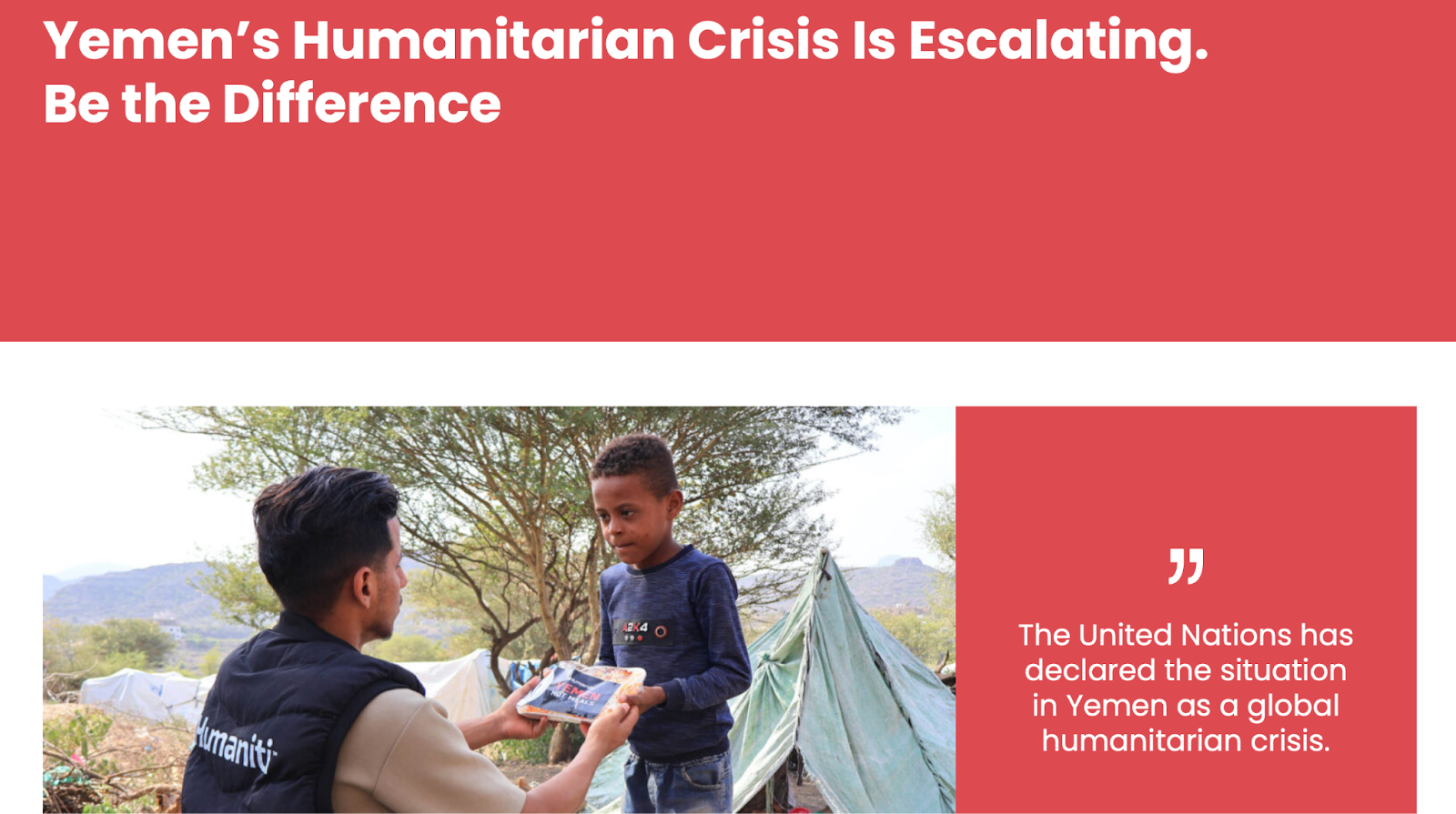
On Humaniti’s website, however, it claims to have operations in countries like Yemen:
A donation page from 2024 (the period covered by the 990), recovered using the Wayback Machine, also claims Humaniti has operations in Pakistan, Afghanistan, and Palestine. Various Islamic scholars and public figures also appear on the page backing up the charity, as well as its so-called “100% Zakat Policy.” The tendency of Islamic scholars and public figures to endorse just about any low quality and scammy thing that comes their way is a chronic problem in the Muslim community. The presence of a phalanx of Islamic scholars and influencers shilling for this kind of trash gets no less depressing the more you realize how common it is.
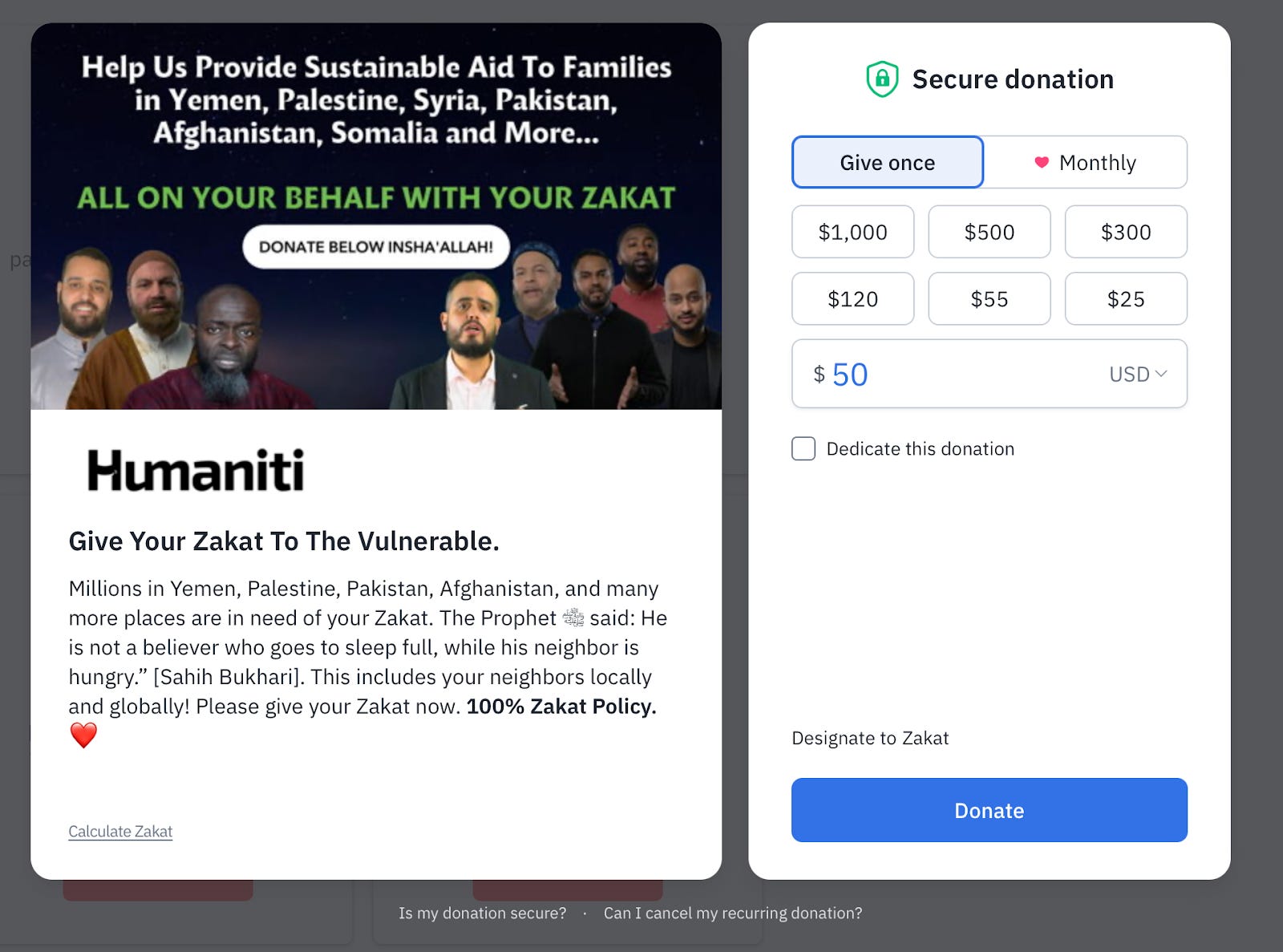
The 100% Zakat Policy still exists on the website today, only the 990 shows no restricted funds at all. Humaniti does not appear to segregate funds. It also lacks an articulated zakat policy other than that impressive fake percentage.
Notably, a board member’s company, Clearoute Inc., received $341,000 over two years in payments for management, consulting, advertising, and “program expense.” Schedule L notes the board reviewed and approved this conflict of interest transaction. However, a board that, according to Part I of the 990, has zero members cannot have reviewed or approved anything. This same company and board member was involved in a commercial fraud case in Canada.
Humaniti’s 990 reports $2.5 million in noncash contributions with a contribution count of zero; that means no donors gave them $2.5 million. This is all quite odd. When I reached out for comment before publication, a response came from a Toronto-based lawyer identifying himself as “in-house counsel.” This appeared to be another employee that the organization’s 990 claims does not exist. His email demanded I provide my complete methodology before any conversation and simultaneously threatened that “publishing unsubstantiated claims could expose [me] and [my] publication to liability.” The lawyer is licensed in Ontario, Canada, and does not appear to be licensed to practice law in Texas, California, or any other US jurisdiction.
Sending a demand letter invoking US defamation law on behalf of a Texas nonprofit may itself violate the law (it’s called unauthorized practice). His letter also vouched that the 990 was “prepared in accordance with IRS requirements” and that the organization maintains “annual external audit processes consistent with governance best practices.” However, Part XII of the 990 says no audit was conducted and no independent accountant reviewed the filing. The 990 is full of contradictions and outright untrue statements, with which I will not bore you.
There appear to be some major red flags of wrongdoing at Humaniti. Texas or federal authorities should ask them some questions.
MUSLIM AID USA (MAUSA)
Rating: Perfectly Mediocre Hisab-Hacker
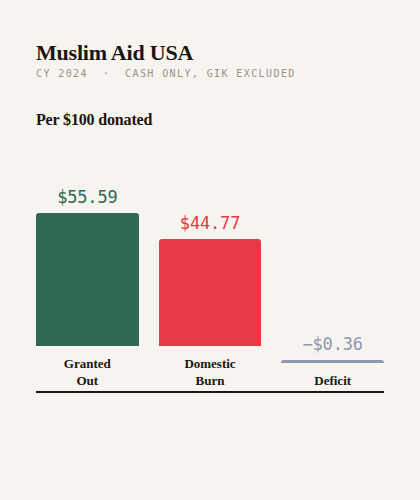
Last year, I was hopeful after a discussion with Azhar Azeez, who was then CEO of MAUSA. We discussed the organization’s zakat policy and that MAUSA would release an audited zakat accounting. MAUSA had (and still has) a zakat policy with real restrictions on how money can be used. However, the organization never did that audited accounting. Or at least nobody in the organization was able to find one, or any evidence that one was requested. There was an “audit” of the policy itself, which I did see. It rated the policy as “fair” but demerited it for being non-specific about beneficiaries and also for depositing zakat in an interest-based account.
I wanted to do a separate investigation into MAUSA because of a wealth of whistleblowers at the organization with a variety of allegations about alleged wrongdoing there. Also, because I felt like I was the victim of a shell game. Much of my research turned out too niche to publish, revolving around business judgements and personality conflicts too tedious for non-insiders to read about. The most alarming allegation from a donor perspective was hisab-hacking, about which I learned from former MAUSA employees.
MAUSA has a good zakat policy among internationally focused Muslim nonprofits in the United States. However, this policy is largely a smokescreen insofar as the organization does not follow its own policy and apparently, does not account for zakat at all. In addition, it has internal management and governance issues that appear intractable.
MAUSA is a pure “marketing-first” nonprofit and if you donate to them, you are really just paying way too much for them to grant money out to someone else. MAUSA’s “cash burn” is 45%, which means 55 cents of every dollar donated gets granted out to other intermediaries, like Muslim Aid UK, Orphans in Need, or ANERA. And those organizations themselves have overhead. Muslim Aid UK also has a waqf, and it is unknown how much money is diverted there. Likely the benefit of no more than 30 cents of every dollar donated goes to a person in need. This is bad, but there are at least half a dozen charities featured in this article that are worse.
MAUSA’s current strategic plan is to improve efficiency, but not enough that it would actually follow its zakat policy.
HUMAN APPEAL USA (HAUSA)
Rating: Unmitigated Sleaze
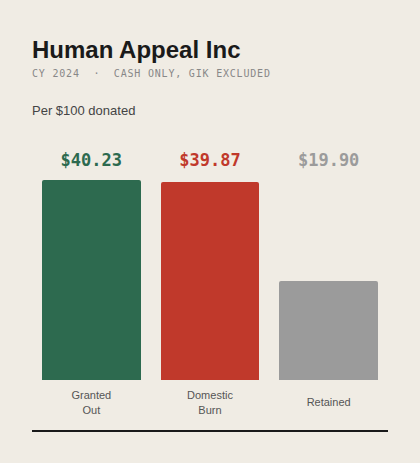
HAUSA is another marketing-first “charity.” Their main job is to market to Americans and send money to Human Appeal in the United Kingdom. They are exceedingly bad at this.
HAUSA is a lot like MAUSA in that it has a restrictive zakat policy. Under its policy, a “zakat overseer” (Human Appeal) cannot take more than 12.5%. Most of the money donated here, nearly 60%, is either burned or hoarded. That means under 40% goes to the UK organization, before they take their cut of overhead. HAUSA is clearly blowing past its 12.5% limitation before money goes to the UK (assuming it is zakat, but there is no accounting), and then to Gaza. What ends up in Gaza or wherever else Human Appeal says it has operations is significantly smaller.
To its credit, HAUSA appears to have a good accounting firm that did its 2024 Form 990. There were no signs of hisab-hacking accounting manipulation present. The organization was also upfront about management red flags like not having a conflict of interest policy. Anyone who cares to look at the tax return knows the organization is objectively a poor performer that wastes an enormous amount of money. It is a grift machine.
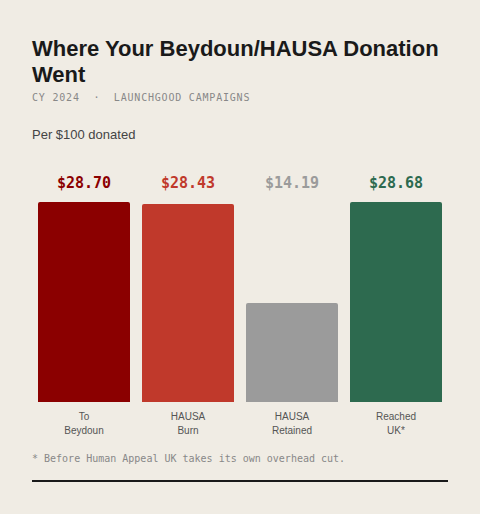
A recent controversy involving HAUSA was that the organization gave 28.7% of its Launchgood zakat campaign donations to Khaled Beydoun as an influencer commission. Launchgood has long been a vector for spam and grifting in the Muslim community. In this analysis, I added commissions back to gross revenue so the numbers are more honest.
If we reverse the gross-up to include Beydoun’s commission as part of the overhead burn and use the numbers provided by HAUSA, a donor giving $100 to a Khaled Beydoun campaign will see a four-way split: $28.70 to Beydoun, $28.43 burned on HAUSA’s domestic operations, $14.19 retained by HAUSA, and only $28.68 granted outside the United States to the UK organization (where further unknown cuts may occur before any money reaches people in need). HAUSA’s domestic burn is distributed across salaries, advertising, and vendor contracts. Khaled Beydoun stands as the single largest individual beneficiary of the donations he solicited.
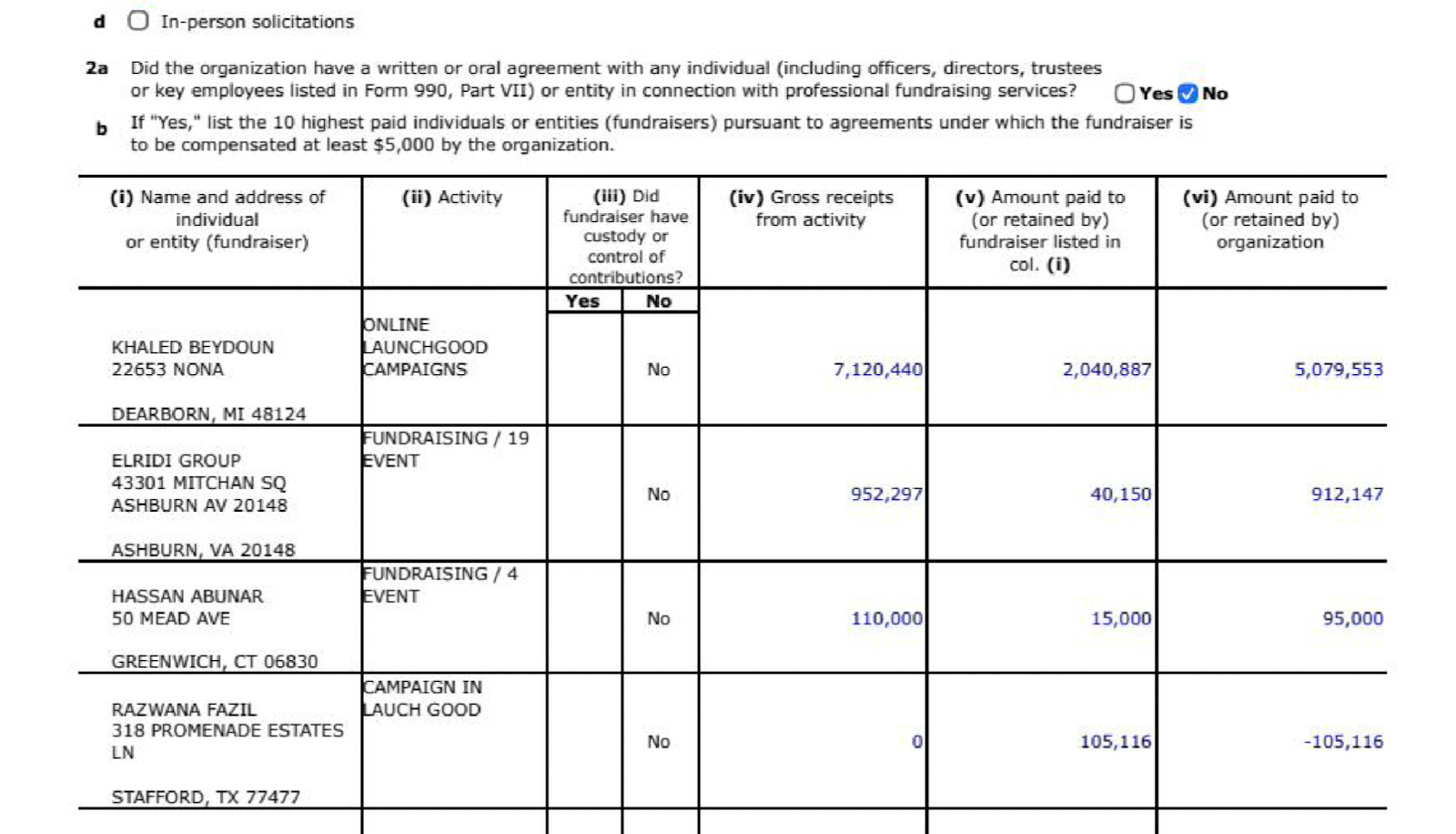
In defending themselves, Khaled Beydoun and HAUSA made claims that made them look even worse. The organization blamed an unknown person who is no longer with the organization for an “error” the charity noticed later. It also invented a new tax form called an “interim 990,” which is not a thing.
HAUSA’s CEO almost certainly electronically signed the Form 990 under penalty of perjury (as required by 26 U.S.C. §§ 6033 and 6065). A willful false statement on a return is a felony under 26 U.S.C. § 7206(1). The 990 itself said that all members of the board reviewed it. This included millions in bizarre and mysterious line items like “Guest Exp,” a six-figure fundraising fee for a Razwana Fazil that delivered zero dollars in donations, $6 million in digital advertising, and over $600,000 to Al Jazeera for media coverage.
The UK-based Zaheer Khan, who is not formally involved with the 990 process, provided his own video statement displaying his obvious ignorance. The act of “assuring” donors without being able to confirm anything was a feat of pulling facts from a dimension not previously known to science.
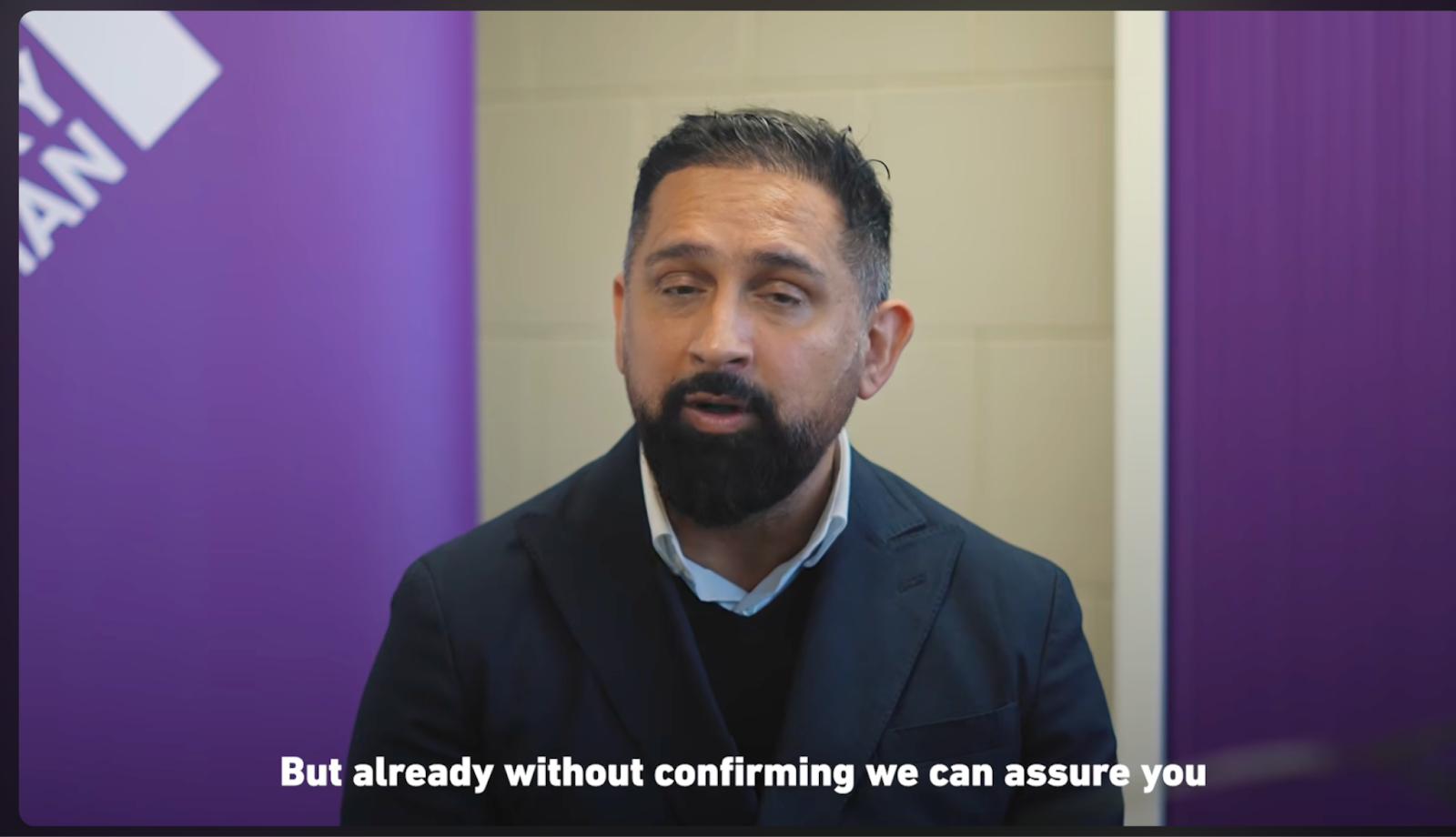
HAUSA is shortchanging beneficiaries in Gaza and Yemen. Beydoun is not zakat-eligible. The organization’s claim that the money did not go to Beydoun but some Islamophobia Studies Center does not help, even if it were true. Further, if donors had wanted to give their zakat to an Islamophobia research organization, they could have done that. They gave money for Gaza and Yemen. It is clear that donors gave to Human Appeal based on false pretenses no matter how you slice it.
There was no disclosure to donors at the point of solicitation that so much of the money was for an influencer commission. This appears to violate the Federal Trade Commission Act, state charitable solicitation registration requirements, and California’s Unfair Competition Law (Bus. & Prof. Code § 17200), which provides for restitution of donor funds, civil penalties of up to $2,500 per violation (there have likely been many), and potential criminal penalties should a District Attorney wish to pursue them. In some jurisdictions this deplorable conduct may rise to the level of felony fraud.
Even if you were to casually observe what is happening in the Muslim charity space, it is hard not to notice how singularly sleazy an operator this organization is. For example, this is the result of a google search for Rahma Worldwide.
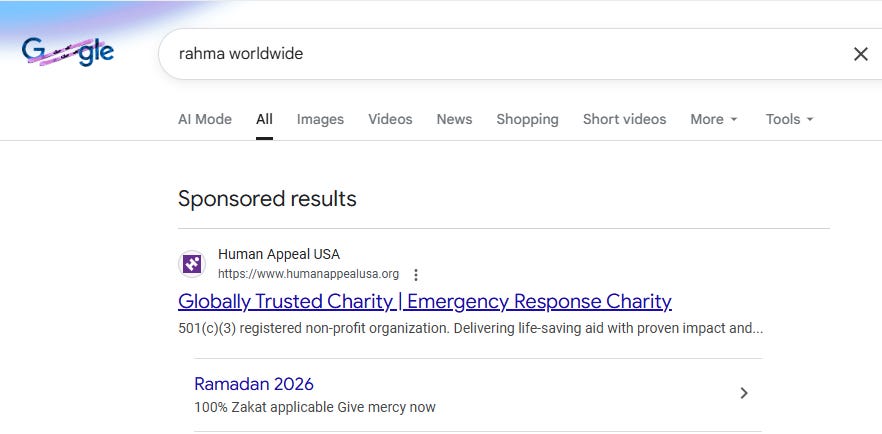
This is a google ad in which Human Appeal appears to have purchased the name of a different charity, then described itself as a “globally trusted charity.” Keep in mind this is an organization that has been dealing (badly) with a scandal related to paying a social media influencer without telling people who thought they were donating to orphans in Gaza. That is a cut-throat, Tonya Harding-style move that I called out in this newsletter a few years ago. From what I can see, Human Appeal appears the most aggressive in this kind of advertising.
What happened with Human Appeal is quite serious and should have consequences. If they are not held accountable, then accountability for Muslim charities is simply not possible. If Human Appeal were the only option for donating to Gaza relief, we might have no choice but to pay the steep grift tax they demand. However, you can and should safely skip this organization. It is difficult to overemphasize how truly rancid this operation is.
UNITED MISSION FOR RELIEF AND DEVELOPMENT (UMR)
Rating: Mostly Fake
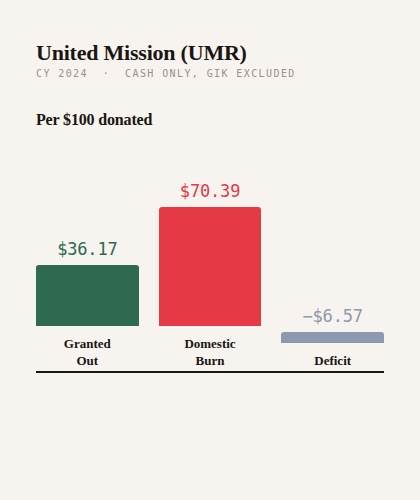
This supposed $150 million behemoth is mostly made out of pixie dust. The vast majority of the money on its books does not exist and never will. UMR uses hisab-hacking, only on a bigger (as bubbles go) scale. They are claiming a program expense ratio of 97.4%, meaning that of every dollar you donate, 97.4 cents go to their charitable program.
If you consider money, the actual thing that you donate, the cash burn rate is 70%. That is the amount that never leaves the office. They spent more than they raised to get a pitiful result. They are not respected within the sector or among their own employees, who report nepotism and mismanagement on glassdoor. The CEO is paid $365,976 for an organization that takes in only $6,867,158, including what are likely significant zakat funds (naturally, there is no accounting). This is obscene, as there is no evidence he offers anything close to a valuable service.
UMR has no meaningful zakat policy or accounting. This organization seems profoundly unserious. Move on.
PENNY APPEAL
Rating: Everything is “Marketing”
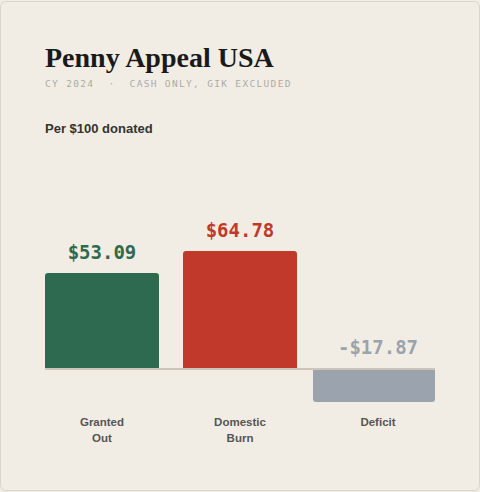
Shahzad Younas has discussed Penny Appeal UK’s conflict of interest and grifting problems so I will not belabor those points here. It may be useful for prospective donors to know the organization has been cited by the (admittedly problematic) UK Charity Commission for a variety of violations repeatedly. The story of its American child organization, Penny Appeal USA, is quite grim. There is likely an internal money loop happening through which insiders are benefiting from fundraising in the United States, as the founder has an apparent interest in marketing.
Expenses for marketing are quite generous. And the organization also does quite a bit of charitable granting that is also “marketing.” So they are marketing to do more marketing in a never-ending circle. Penny Appeal reports marketing both as an expense and as a charitable activity.
Correction: An earlier version of this analysis understated Penny Appeal USA's overseas grant disbursements. and dramatically understated the amount sent to the MENA region. Schedule F Part I shows $2,581,000 directed to the Middle East and North Africa, substantially more than the $236,000 cited in a prior version. I have corrected the chart and have removed the portion that addresses the lower amount. I apologize to readers and to Penny Appeal USA for the error, and thank Sh. Joe Bradford for bringing it to my attention.
BAITULMAL
Rating: The Opposite of Efficient
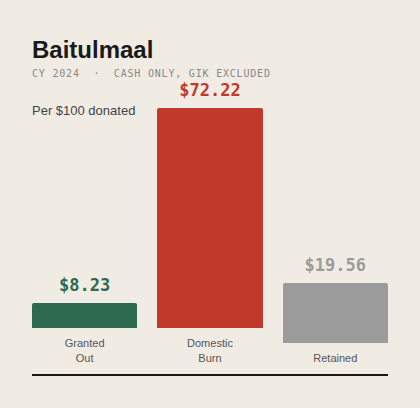
Baitulmal is another marketing-first charity. While it prides itself on its efficiency, like some of the other candidates on this list it relies heavily on fake numbers with gift-in-kind hisab-hacking. We ignore those figures here because they are deceptive. While the organization claims 91% of donations go towards programs, it prefaces this by breaking down what happens to “your donation.”
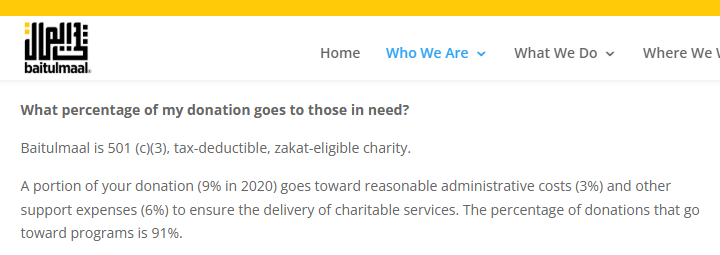
This is false. When you strip out the hisab-hacking and look only at real cash and where the organization says it went, or can’t tell you at all, the picture looks hideous. The organization also deploys cash aggressively on domestic marketing, including giving money to masjids so they can market to Muslims. The audited financial statements code $181,140 in “Contributions” to the fundraising column, confirming this characterization. So I do not count them as grants; they are cash burn. They make masjids complicit as part of their business plan of lying to Muslims.
The money trail problem with this organization is quite alarming. What Baitulmaal claims it gave in programs does not match what it wired overseas as shown on Schedule F of the 990. There is a $10.4 million “financial and material assistance” line item that sits unexplained in both the 990 and the audited financials, not granted to any identified recipient nor sent overseas. The auditor seems to have no idea what this massive amount of money is for. It appears to have gone nowhere. I am counting it as cash burn because that appears to be the most accurate characterization. I reached out to the organization with no response.
HELPING HAND FOR RELIEF AND DEVELOPMENT (HHRD)
Rating: Bloated Hoarder
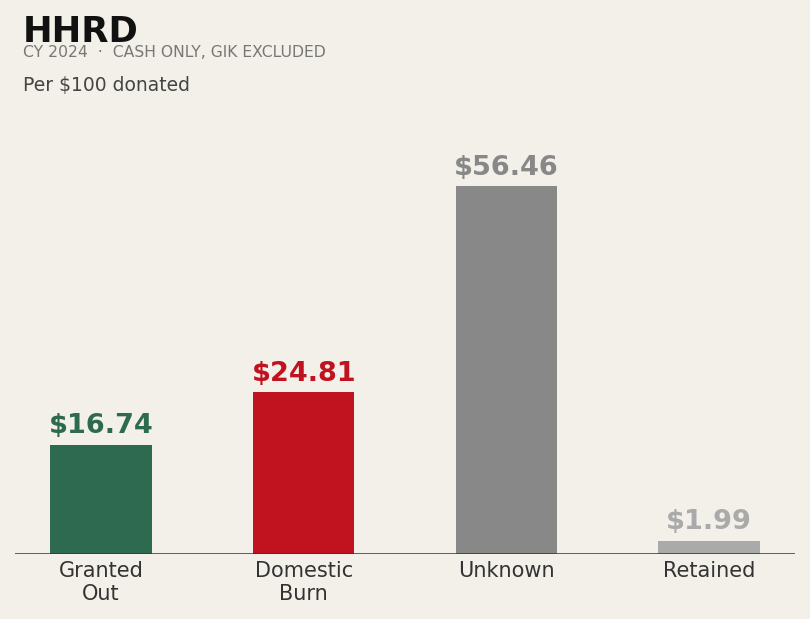
HHRD reports a program expense ratio of 91.7%, largely attributable to hisab-hacking. Strip that out, well we have a problem with transparency.
The organization employs 155 people across 15 domestic offices but has no charitable programs in the United States. Former employees who have spoken to me in past years have described the existence of no-show or light-duty jobs for connected individuals. Glassdoor reviews describe nepotism (also disclosed in the 990) and a family-connected, centralized leadership culture. The organization has lost money on fundraising events overall. Its $9 million payroll supported $59 million in fundraising revenue, without counting advertising separately.
The most striking feature of HHRD’s finances is its cash accumulation. The organization sits on an extraordinary pile of money that is doing no charitable work. It has $19.5 million in “receivables” from its own foreign subsidiary offices—money transferred overseas that has never been spent on charity—combined with $49.3 million in US cash. That is nearly $70 million parked for an organization with annual revenue of roughly $59 million.
Do not donate here unless you have decided that warehousing money indefinitely is a valid zakat purpose.
Note: A prior version of this article stated that money had been hoarded. A substantial amount of what is happening here is unknown. I will write another article shortly explaining why.
HIDAYAH FOUNDATION
Rating: Not Bad, but No Zakat
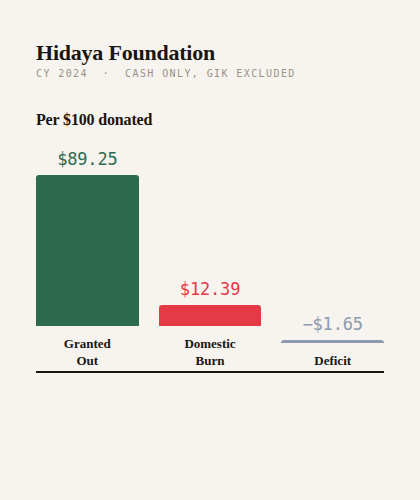
Hidaya is the most financially lean organization in my dataset. Its management compensation is modest for a Silicon Valley organization. It has minimal potential hisab-hacking by sector standards. For every $100 donated in cash, approximately $89 reaches grantees and field operations, with about $12 in domestic overhead, drawing slightly on reserves in a mild deficit year for the 2024 reporting period. You should still not donate your zakat here, since it is not evident they would know what to do with it other than tell you that you should pay it to them. They have no zakat policy and, like the rest of the sector, no separate zakat accounting.
Hidaya does not primarily operate as a grantmaker in the conventional sense. It seems to use small local partners. Most of what they do is not visible in the 990. They also seem to emphasize being anti-terrorism, claim to scrutinize their board members against suspect lists, and make their partners read antiterrorism guidelines. This emphasis is a bit unusual.
Hidaya is not completely opaque, but it is a bit mysterious how it spends internationally. The audited financial statement, published on their website and dating back to 2011, shows a consistent and modest overhead structure.
The limitation is that this model is inherently unverifiable from public filings. Schedule F stops at “Africa—Program Serv” and “Asia—Program Serv.” The local agents are not named anywhere. Donors have no way to independently confirm that stipends reach the widows and orphans pictured in fundraising materials, or that food distributions occurred as described. Hidaya says they require completion reports, photographs, and receipts from partners, but donors will not see these.
Here the opacity seems to be more because of their operational model, which relies on local providers, rather than an attempt to hide. But from a donor’s perspective, the practical result is the same: you cannot verify where your money went. Hidaya appears better than the other organizations here. It is not, however, one that you should trust your zakat with yet.
ISLAMIC RELIEF USA
Rating: Substantial Assets but Improving
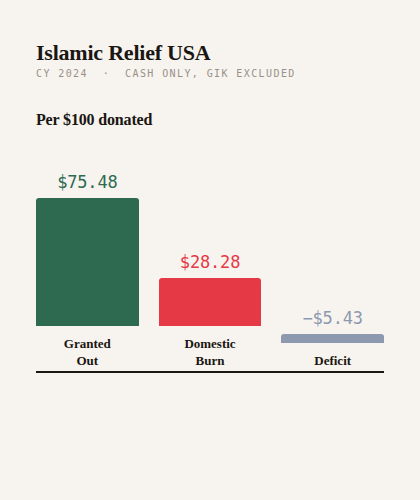
I have written about Islamic Relief extensively in past years. The organization ignored the restrictive zakat policy of its UK parent (Islamic Relief Worldwide is related but independent) and created a new zakat policy that limited administrative overhead to 20% instead of the previous 12.5% on zakat. In practice, however, it can exceed these limits whenever it chooses. The organization’s zakat policy allows for an essential part of their business model: facilitating donor churn from digital marketing. That is the practice of using donor dollars to find new donors. They spent nearly $6 million on google advertising alone. Islamic Relief USA has also not prioritized using any of its substantial funding to invest in zakat accounting so donors can know what it is doing. However, we do know their policy allows large amounts of zakat funds to be used to fuel advertising on Google, including things like this:
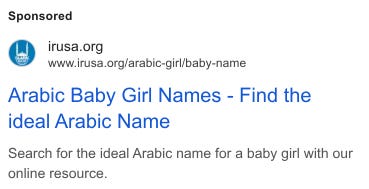
Here, Islamic Relief USA is trying to corner the expectant parent market. Then there is this:
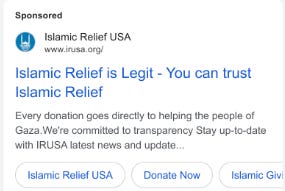
Islamic Relief USA wants potential donors to know it is “legit”, which seems reassuring. It also claims “every donation goes directly to helping the people of Gaza.” As Islamic Relief USA has no offices or presence in Gaza, how they would “directly” help the people of Gaza is a bit of a mystery (though plainly they sent grants to organizations operating in Gaza).
The 2024 donation picture looks a bit better than prior years, since it is drawing from a meaningful stockpiling of assets (to the tune of $228 million, but $64 million is in cash, there are pledges and GIK inventory on their balance sheet). This is a meaningful amount of money and assets for a Muslim organization to which people have been donating to help the needy that we are urgently being asked to help.
I first wrote about Islamic Relief in 2022, when the charitable value proposition of the group became alarming. They have improved their grant-out percentage since. Indeed, they outperform most organizations in this group. However, their impossible to fail zakat policy and no accountability for how it is spent makes this marketing first nonprofit a no-go on zakat.
There was a correction here from the initial publication. I have added some nuance to this organization’s profile. I also made an error regarding the nature of the assets held by the organization, though the amount was what they reported. My apologies for this.
10
ZAKAT FOUNDATION OF AMERICA
Rating: 100% Not for Zakat
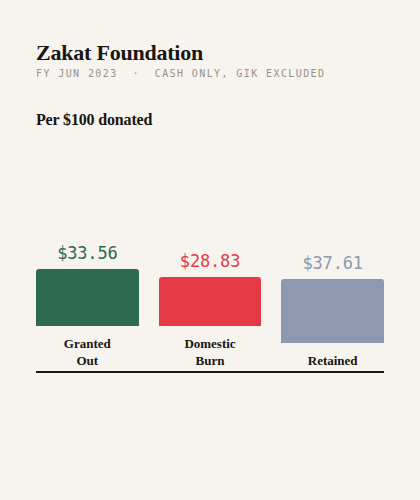
Zakat Foundation plainly wants zakat. But they don’t have any zakat policy that limits them in any way, other than a general directive to follow the Qur’an and Sunnah. Nothing an auditor can sink their teeth into. The organization operates partly as a direct implementer with its own overseas field offices, so the $33.56 grant-out figure understates actual beneficiary reach. The more serious concern is reserves: $28.2 million in net assets against $17 million in annual expenses—1.7 years of runway for an organization that solicits urgently for disaster relief and zakat. The name implies a level of zakat rigor the organization has never demonstrated. No meaningful, restrictive zakat policy and no accounting. This group also appears to have centralized family control. This is not an appealing donor option.
11
LIFE FOR RELIEF AND DEVELOPMENT (LRDI)
Rating: Misleading Advertising
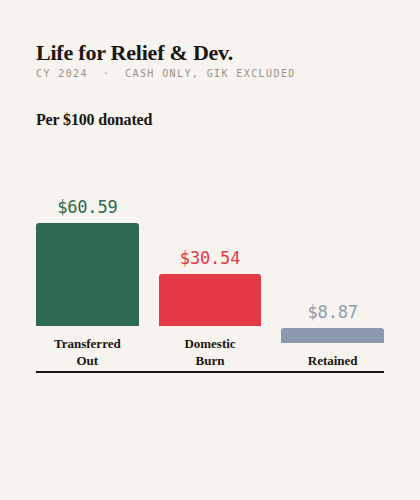
Life for Relief and Development is a direct implementer with its own overseas staff and operations. This is a different model than the marketing-first charities above, and deserves different evaluation. However, the organization relies heavily on pharmaceutical hisab-hacking with $20 million in such contributions that inflate apparent program ratios. The domestic burn is quite high as a result.
Life for Relief and Development uses hisab-hacking to make the untrue claim that 95% of your donation goes to its intended destination.
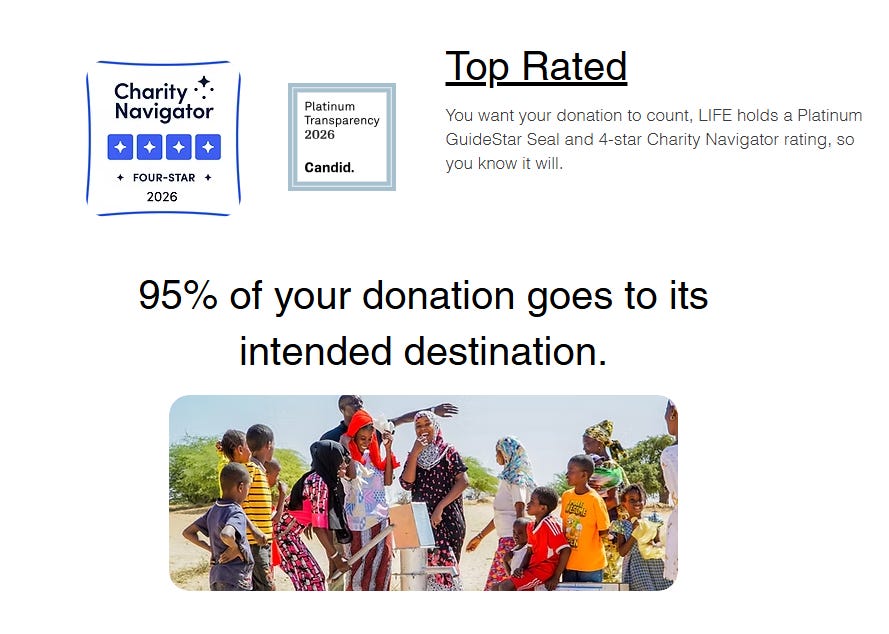
Your cash donation is cut up a lot more than that.
The organization does not advertise zakat on its website (mentions it as an aside), let alone have a zakat policy or accounting. It will take your zakat if you want to give it to them. This is not a great use of your money.
PURE HANDS
Rating: Time for Some Soap and Water
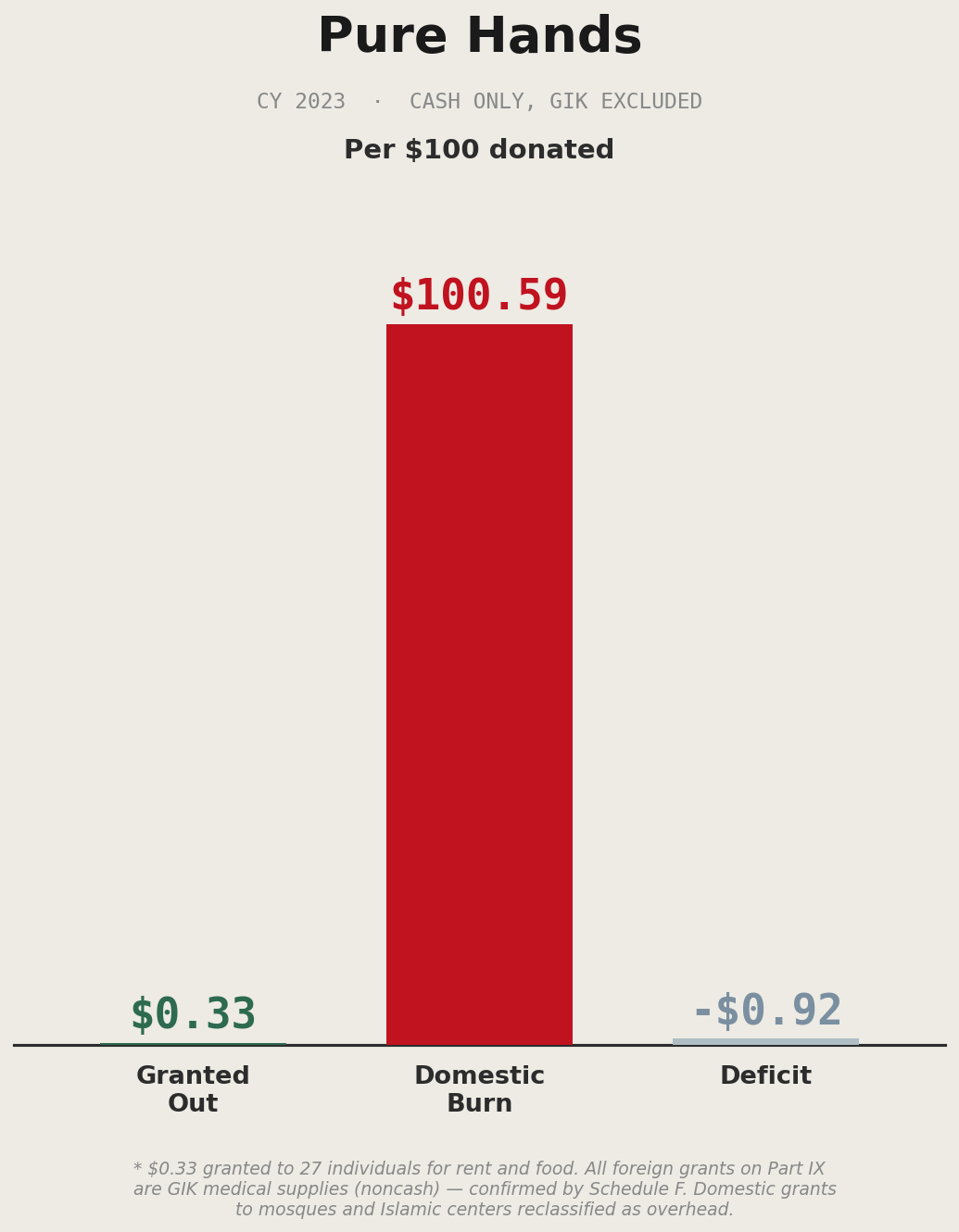
One of the more ridiculous charts we have. This organization is almost entirely a hisab-hacking vehicle. Reported revenue of a bit under $185 million is over 94% noncash contributions from a single Dutch supplier, IMRES Netherlands. The cash grants to masjids are treated as cash burn since they are for marketing to Muslims. There are a handful of domestic grants to individuals that appear in the “granted out” bar.
This organization serves no real purpose. Donors who think they are giving to Yemen relief are just paying for masjid sponsorships, travel, and salaries, and acting as a conduit for a supplier of goods being shipped. They have no zakat policy or zakat accounting.
HUMAN DEVELOPMENT FUND (HDF)
Rating: New Zakat Policy to Validate Management
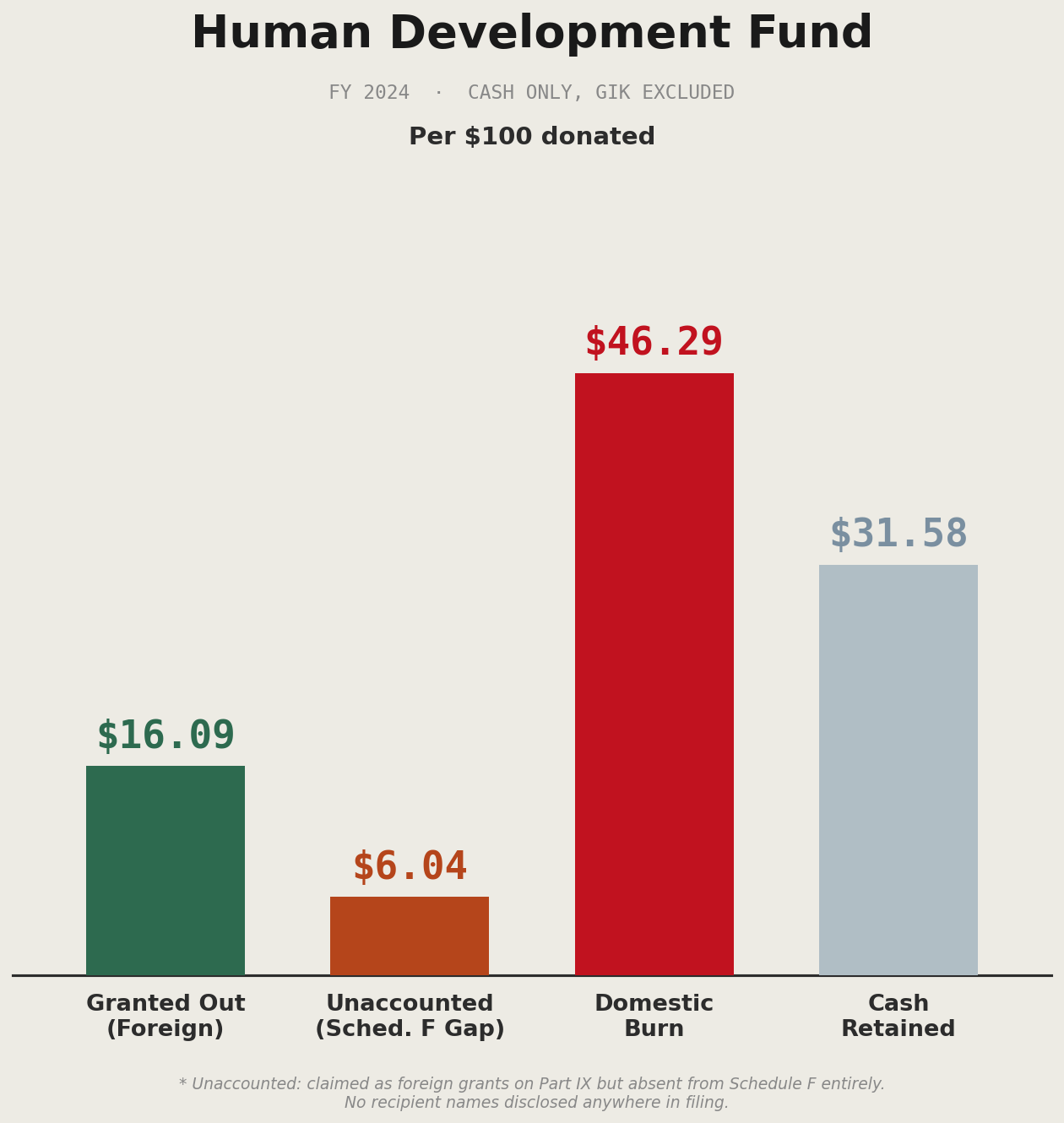
HDF is another marketing-only charity. I am counting domestic granting here as “cash burn” because it all appears to be transactional as marketing and donor acquisition costs. These payments also do not fit with the organization’s mission. As to the various reporting issues below, I asked for comment on a variety of concerns with this organization. Management stated they deserve the benefit of the doubt and wanted to talk to me about this. However, we could not get a call together. My questions were conveyed in writing and they were unable to provide answers by publication (and the call likely would not have answered them). If they do offer a written response, I will share it.
HDF has shown with their granting that they want religious legitimacy for what is, by the numbers, a substandard operation. They have developed relationships with Islamic scholars and paid organizations affiliated with them handsomely. In some cases, the grants appear to be hidden. For example, one is a $722,000 grant to something called “International Islamic Health,” which sounded fake to me. I confirmed this by learning the employer identification number corresponds to Miftah institute. The Al Jazari Institute gets two grants (one under a different name) totaling $290,510. Qalam Foundation was paid $52,000. None of this is obviously related to the organization’s mission.
The overseas grants go to unknown entities though the grants out are quite miserly for a charity. Some of them were unaccounted for on Schedule F, which is where the unknown bar comes from.
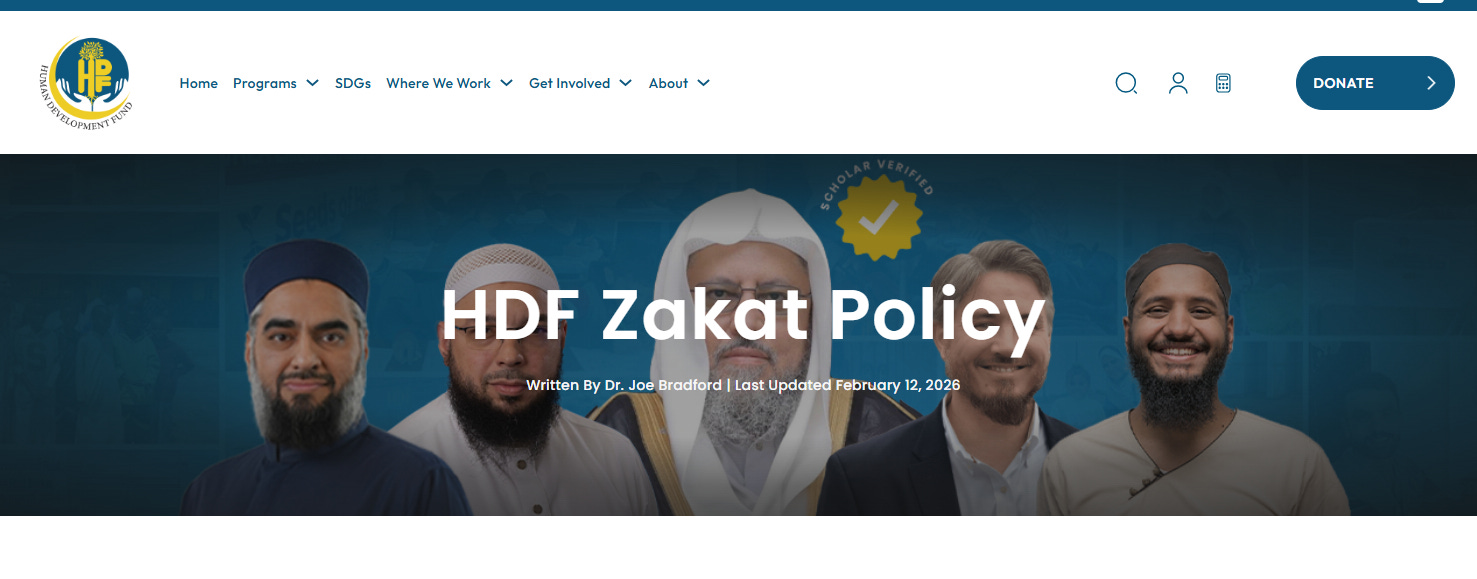
As it happens, the organization has a new zakat policy, written and approved by various scholars. It serves as a rubber stamp for management and has no concrete requirements or accountability mechanisms. For example, when it comes to administrative costs, it says “Administrative overhead is limited in accordance with Shariah and subject to Shariah Advisory Board oversight.” Notably, the policy does not even promise a separate zakat accounting. There is not much for this board to look at. There is no way for HDF to violate this policy, because the policy contains nothing to violate. As a donor, this does not tell you anything. It is perfectly possible to limit administrative expenses with a number and account for zakat. It is also possible to have a policy where donated zakat money actually goes to zakat beneficiaries instead of being hoarded. It is plainly in HDF’s interests to have a policy be as squishy as possible. These scholars certainly delivered.
It is remarkable HDF needed to hire a clutch of scholars to create a policy that told the organization to follow basic Islamic jurisprudence (a clutch of scholars looking at the camera is a familiar American Muslim marketing trope), and also, to do whatever they want. It includes vignettes such as:
Donors may designate a specific purpose for their Zakat contribution (e.g., orphan care, livelihoods). HDF allocates such restricted funds strictly in line with the donor’s instructions. Unrestricted donations are allocated at HDF’s discretion, guided by strategic priorities and immediate beneficiary needs (emphasis added).
This same group’s faces also appear on the HDF zakat calculator. I tried it out. It has a category for “Business, shares, savings, certificates.” It treats a business you own, a savings account, or a publicly-traded stock all the same. That is an odd thing to write with scholars’ faces up there. I wrote in $1,000,000.
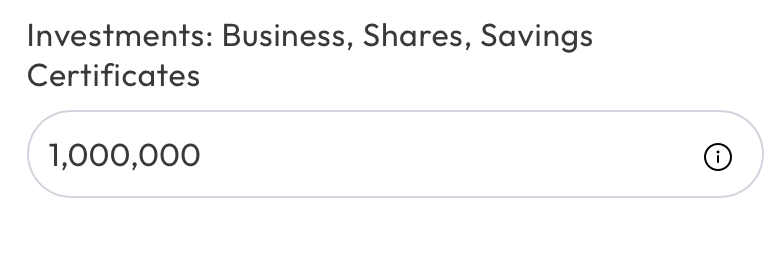
The zakat I owed to HDF? $25,000.
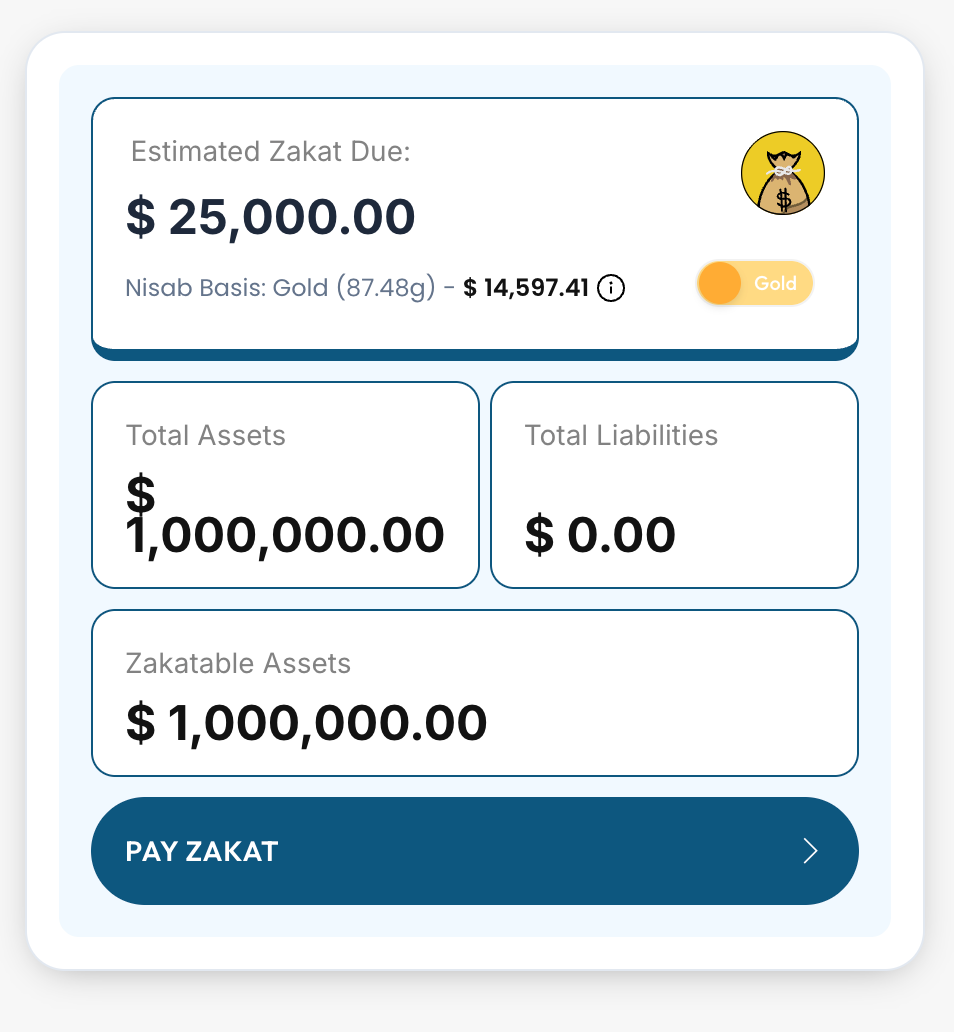
Virtually anyone with a nodding familiarity with zakat and business should know this calculator is dead wrong. Shaykh Joe Bradford, author of the HDF zakat policy, has a zakat calculator significantly more nuanced. If you have a business, it will ask you what kind of inventory you have at wholesale prices. It will not just ask you to value your whole business as if it were a savings account. HDF is not unique in that it has a zakat calculator that makes everyone overpay. It is different in that it makes it appear as though scholars support it.
When you donate your zakat to HDF, most of it goes toward burning and hoarding money, investing it, and then losing money on those investments. They got some scholars to tell them they can do whatever they want. This is indicative of how so much of this sector works.
If you want scholarly approval for a zero-accountability zakat policy and a calculator that knows how to get 2.5% of something, Human Development Fund is your Huckleberry.
RAHMA WORLDWIDE
Rating: Will Get to it Someday
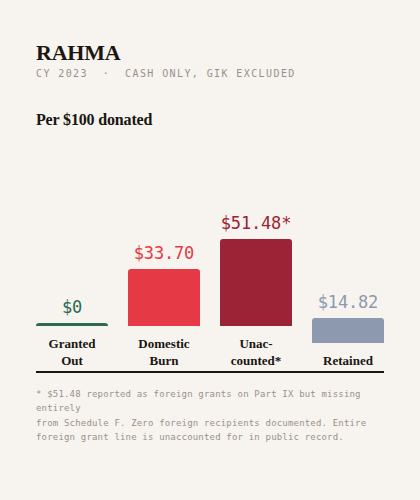
Rahma’s zakat policy is written in the future tense. They “will open up a dedicated zakat fund.” Not have. Will. There are no current restrictions on fund use—no segregated account, no distribution methodology. This is not a zakat policy but an aspiration. The 990 also has some major reporting failures. Rahma, to its credit, responded to my pre-publication inquiry and conceded to reporting discrepancies I identified and stated they will address them.
The biggest concern with Rahma is a $5.85 million hole. Part IX Line 3 reports $17,454,433 in foreign grants. Schedule F—the schedule that explains where foreign money went—accounts for $11,603,290. That leaves $5.85 million, about 34% of all reported foreign grants, with no home anywhere in the public filing. You will note my diagram says zero is shown as granted out. That is because what is granted out is hisab-hacking, goods sent of unknown value but primarily as an accounting device. What is missing is the cash, the thing human beings donate.
Rahma’s response tries to explain this away. They point out, correctly, that Part IX Line 3 is broader than Schedule F Part III, which only covers grants to individuals. Fair enough. Grants to foreign organizations would appear on Schedule F Part II instead. Here is the problem with that explanation: Schedule F Part II is completely blank: no organizations, no amounts, no regions. The organization’s response to my question actually makes the problem worse. Rahma responded to a further inquiry stating they will check with their accountant to see what happened since they are busy.
They also concede that Part III of the return says “including grants of $0” while Part IX simultaneously reports $17.5 million in foreign grants. These are on the same tax return. They blame the preparer and say an amendment may come.
On the $11.6 million in noncash medical supply contributions, no Schedule M was filed. Schedule M exists specifically to document what those supplies were, who valued them, and how. Rahma’s explanation is that valuation came from “fair market value provided by donors.” Donors valuing their own contributions is not independent; it’s the kind of hall of mirrors valuation that Schedule M is designed to surface and scrutinize. Upon further inquiry, the organization informed me there are no actual “donors” for this stuff in the traditional sense. Rahma purchases the items from a supplier and inflates the value either 33:1 or 42:1. Essentially the scarf example I provided in the beginning of this report.
Rahma’s 89% program ratio claim is a hisab-hacking artifact. They pay for goods. Strip out the noncash contributions and the picture looks, well, pathetic. There are no cash grants accounted for at all, since I count the $5.85 million as still waiting for a coherent explanation. Rahma is like a charitable organization missing both the “charitable” and “organization” parts. Perhaps one day they will account for zakat, and for cash in general. But today is not that day.
INDIAN MUSLIM RELIEF AND CHARITIES
Rating: Lean Except for the Bad Investment
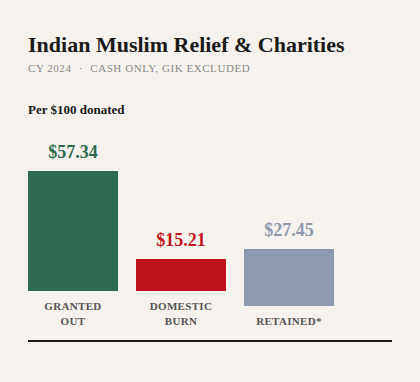
This organization is usually quite efficient. The hit they took for the 2024 reporting period was because they lost money on an investment. In GAAP accounting that means lower net income, which is what the 990 shows. However when a donor donated, they did not donate to have their money wiped out by some written-off investment. So we count that as domestic cash burn, as this newsletter takes the donor perspective on things.
Executive compensation is quite modest, particularly for Silicon Valley (similar to what we saw with Hidaya Foundation). It has no zakat policy. However the 990 lists a $3.5M asset labeled “Baitulmal Zakat,” (no relation to the organization of the same name) which is more zakat awareness than any other organization in my dataset shows, but falls short of a formal segregated fund with policy or accounting controls.
For a “relief” organization, IMRC has an odd fixation on building an investment portfolio. It objectively has an asset accumulation focus, with eight times the assets compared to annual expenses. Donors generally want donations to go to relief—it is in the charity’s name. However, the model that has been promoted over the years is that overhead (which is lean) should be covered by investment returns from a waqf. This way, more of the donor’s assets will be used towards the organization’s mission. This is perhaps defensible. Indeed, it is a fantastic solution for organizations that accept zakat. Only, at least in this reporting period, this has not happened.
This is perhaps the most promising organization in the sector when it comes to zakat. However, I cannot recommend it for zakat because there is no zakat policy or separate accounting. They have demonstrated some level of awareness of zakat that goes above and beyond others in the sector, and they should get credit for that.
MERCY WITHOUT LIMITS
Rating: Better than I thought
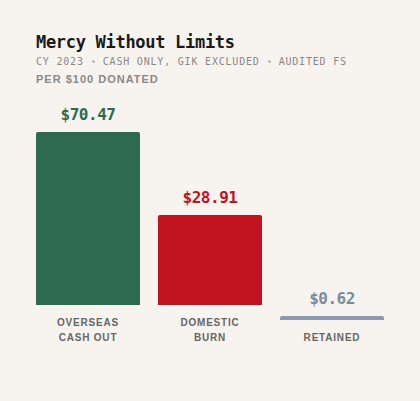
Mercy Without Limits is another organization that uses hisab-hacking as part of its repertoire. As with other organizations here, we stripped that out. They are, however, a direct implementer rather than a purely marketing-first charity, with an extensive presence in other countries. They have a massive payroll overseas. I do not know if that means they are more efficient or not, but I want to treat them fairly since opaque costs would be borne by marketing-first charities as grants.
They have a restrictive zakat policy, but you need to click on the donate button to find it. They do not account for zakat at all, so the policy is not of much use.
This organization has some potential if they accounted for zakat. They are not there yet.
Note: This review has been updated following a review of an error and additional information provided by the organization’s CPA, including direct grants to overseas offices and a zakat policy that was hard to find. I will write about this in a subsequent article.
DROPLETS OF MERCY
Rating: Death by Influencer
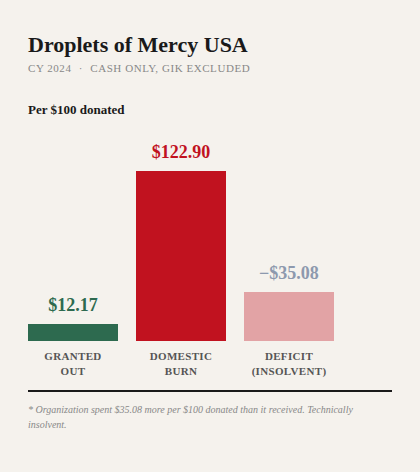
This organization, created by modest fashion influencer and CEO Lisa Vogl, is a cash furnace. It burns significantly more money than it takes in. It also advertises six times more than it gives in foreign charitable activities. Influencer promotions with “Blonde Muslim” and Imam Khalid Latif appear to be extremely wasteful. The organization sends budding influencers to Pakistan and Uganda for free if they raise $5,000. It’s easy to burn cash on poverty tourism junkets. They are plainly experiencing a donor acquisition death spiral.
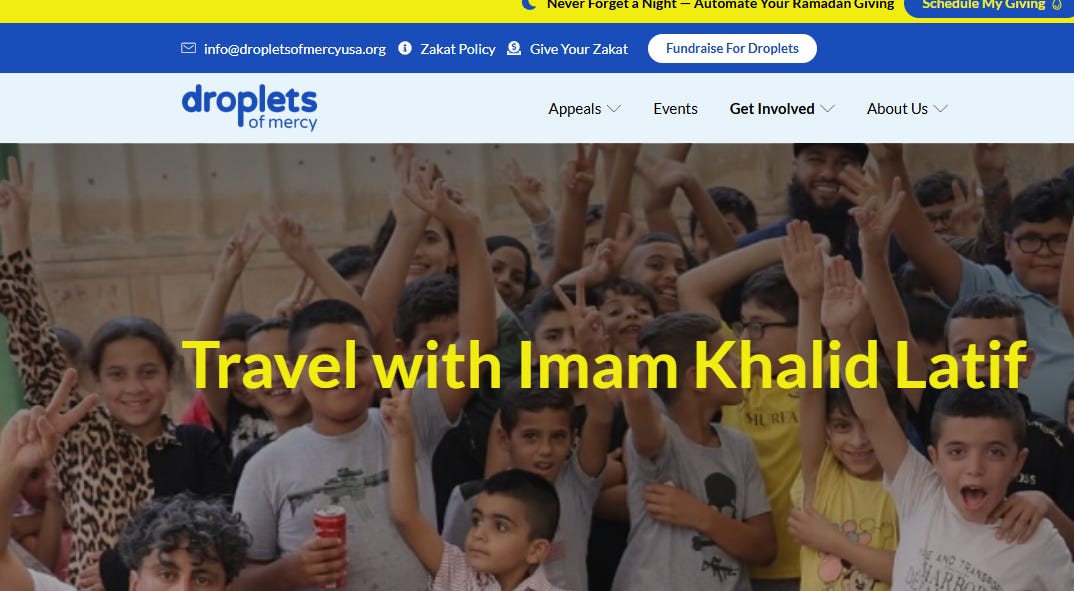
Droplets of Mercy’s 990 does not report what “The Blonde Muslim” or Imam Khalid Latif received, and there are no professional fundraisers listed or registered in Virginia, where the organization is based. It appears Droplets has not registered as a charity with the state of Virginia at all. This seems to violate Virginia law and the Federal Trade Commission Act. Videos reviewed of Droplets of Mercy for this article did not include the disclosures of compensation. Under the law, however, a free trip is compensation.
This organization is technically insolvent. They did, however, get a loan to float them as they incinerate donor cash. Amazingly, Droplets of Mercy has an actual restrictive zakat policy. Not only does the policy restrict administrative costs to 12.5% (ha), it prohibits the use of funds for fundraising costs, influencer fees, events, any advertising including google, and any advocacy or campaigns. It is actually a pretty fantastic zakat policy. The reality, however, is that there is no accounting or segregation mechanism (which the policy requires) and plainly, the organization has demonstrated they do not seem to care much. Their influencer junkets easily make a mockery of any zakat rules. It seems like a “zakat policy” is just a box checking exercise for some donors. We need to look deeper.
Part 3: So Where Do I Donate?
This report on international zakat organizations shows sector-wide rot, accounting deception, and corruption is completely normal. Many of these groups will be welcomed at your masjid this Ramadan because they will pay for the privilege. But do not think of that as your only zakat option.
One potential alternative this year is to Give Directly. While there is no complete documentation of this yet since it is a new program, Give Directly has a zakat program in which 100% of the money you donate goes to a zakat-eligible Muslim family in Mozambique. This is not a review or an endorsement, but if you are interested in this program you should check it out. The organization is long established and well known in philanthropy. While they normally charge overhead, for the zakat program the overhead will come from other funds.
The United Nations Relief and Works Agency (UNRWA USA) changed its zakat program recently. Hani Almadhoun, its Senior Director of Philanthropy, has told me the new zakat program will be 100% cash, dollar for dollar. You donate $500, it goes to an interest-free, segregated Jordanian bank account, and results in a $500 cash distribution to someone in Gaza who needs it. The website still says zakat includes food and water. I asked how this is accounted for, and Almadhoun assured me it is not food and water but simple cash. However it is noteworthy that the website still says food and water in various places. Obviously I do not have a problem giving people food and water. It is just that this is where overhead lives and that would make the 100% benefit more questionable. If they are able to document this program more accurately it may be a solid international option.
I have also previously written about the United Nations High Commissioner for Refugees (UNHCR), which has a 100% cash-to-beneficiaries zakat program to some countries. It comes with some asterisks but it may suit your needs.
You should also consider local options for zakat. There are many organizations including Masjids with zakat programs that are more transparent and accountable. This is in large part because the opacity inherent in international zakat is not present, and masjids rely on volunteers who do a lot of the work. You might consider being one of those volunteers.
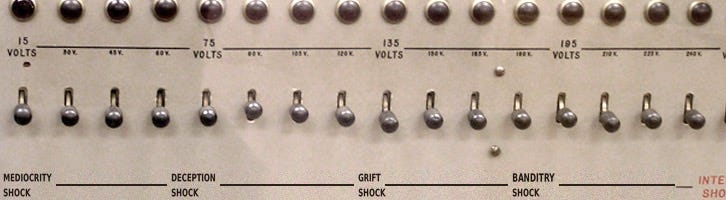
Zakat is a Milgram Experiment
O believers! Indeed, many rabbis and monks consume people’s wealth wrongfully and hinder ˹others˺ from the Way of Allah. Give good news of a painful torment to those who hoard gold and silver and do not spend it in Allah’s cause. (Qur’an 9:34)
The sheer amount of money involved in the charity sector means it can pay masjids, imams, and public figures. These are the people and institutions with unique power to check this increasingly lecherous industry. But instead they lend their name as social proof to what are often scams that do not benefit the poor. The primary culprit here is the Islamic scholarly class, though certainly not all scholars, as Mufti Abdullah Nana has recently called for greater standards and accountability. This is a step in the right direction.
Imams and scholars are often paid by charities and give religious cover to just about any nonprofit practice. Scholars will endorse charities even when their actual practices differ dramatically from the scholars’ own stated beliefs about zakat. They may also speak at fundraisers, create social media posts, or even write zakat policies for “charities” that are lying and cheating. They are the voice in this tragic Milgram experiment on zakat, that authoritative voice telling American Muslims to turn up the voltage again and again, increasing grift, unaccountability, and thievery. This authoritative voice masquerades as virtue, while pulverizing the rights of the poor.
For Muslim scholars, imams, public figures, and masjid leaders who are approached with opportunities to work with zakat-collecting charities and do not want to be that voice in the Milgram experiment, the right move would be to ask a few simple questions (more useful questions than asking how much the honorarium, commission, or sponsorship will be). Ask the organization: have you adopted a zakat policy that meaningfully restricts your use of funds? Was your policy created by scholars who were not compensated by the organization itself? Zakat policies should be standardized across the sector. Do not be impressed with the names who signed off on the policy if the policy is practically impossible to violate. Understand the difference between a scholarly opinion and marketing hucksterism.
Another question worth asking is whether the organization segregates zakat funds and makes a separate accounting public. A possible standard the organization may adopt with some meaningful revisions for increased transparency in the US context is PSAK 409 from Indonesia. An accounting standard does not restrict how an organization spends money (that is the policy); an accounting standard is for transparency. There are several examples of good zakat policies that are completely meaningless because there is no accounting at all.
It is okay to say no to these charities. Muslim leaders, scholars, imams, and everyday donors have the power to bring greater sanity and iḥsān to the world of international zakat. These charities were never the real problem; they only operate the way they do because our society tolerates grift and deception to the harm of the poor and needy.
If you are a Muslim donor, you will likely have your own questions. In trying to get them answered, you may encounter appeals to authority. When that happens, understand that you are in the Milgram experiment, being asked to flip the switch. Don’t.
--------------------
Relatively few people will read this report and feel it raises important issues. If you are one of them, thank you. If you believe it could be valuable to others—Muslim donors, masjid leaders, scholars, imams—please consider forwarding it to them, along with your thoughts on why it is worth their time.
If you have not already subscribed, please do so. All articles are free, though not released at a regular cadence. Paid subscribers help defray editing costs and are appreciated.
What a mess they've all created. I'm seriously thinking of just giving money directly to people instead of going through a non-profit. They're playing fast and loose with other people's money - Allahu Akbar.
a thorough expose. You are a must follow for the US Muslim community